

Dr. Ghida Ibrahim (Ex-Meta, VP of Product and Data at Sector Alarm (KKR)) is running a live cohort-based-course on July 24.
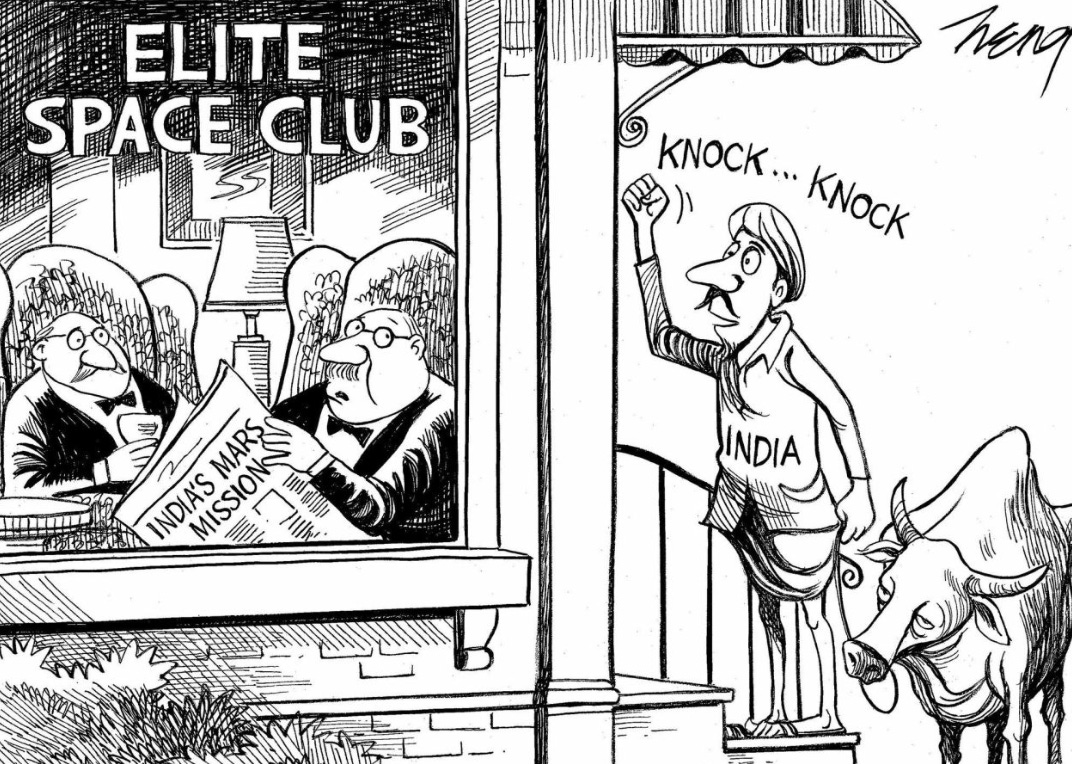
In 2014, The New York Times published a cartoon after India’s Mars mission showing an Indian farmer with a cow at the door of an “Elite Space Club”.
Yesterday, India became the third country to achieve orbital launch capability through private enterprise.
Learn more about the commercial space industry in our masterclass by Harvard Business School Professor Matthew Weinzierl.
Homer, the Iliad, and Why the Greeks Still Set the Terms of Our Speech
The Iliad is a war poem. It covers a few weeks in the tenth year of the Greek siege of Troy and takes as its subject the rage of Achilles, the greatest of the Greek warriors, and what that rage costs everyone around him. The Odyssey is a homecoming poem. It follows Odysseus, the cleverest of the Greeks, through ten years of wandering after the war as he tries to return to Ithaca, his wife Penelope, and his son Telemachus.
We covered the Odyssey in summary in an earlier newsletter. You can review it.
100 Great Books: (Book 17: The Odyssey by Homer)
We are hosting a meetup in Delhi on December 23. Join us.
The Odyssey on Screen, and the Noise Around It
Christopher Nolan’s adaptation of the Odyssey opened worldwide on 17 July 2026. Universal produced it on a budget of roughly 250 million dollars, and it is the first feature shot entirely on IMAX cameras. Matt Damon plays Odysseus, Anne Hathaway plays Penelope, Tom Holland plays Telemachus, Robert Pattinson plays the suitor Antinous, Zendaya plays Athena, Charlize Theron plays Calypso, and Lupita Nyong’o takes a dual role as Helen of Troy and her half-sister Clytemnestra.
Critics have given Nolan the best reviews of his career, with an approval rating around 95 to 96 per cent on Rotten Tomatoes, ahead of The Dark Knight and Memento. Audiences awarded it an A CinemaScore, and the opening weekend reached roughly 120 million dollars in North America and about 257 million worldwide, the strongest global debut of Nolan’s career.
The controversy preceded the acclaim by months. The loudest strand concerned casting. Nyong’o’s Helen drew sustained criticism from commentators, who argued that Homer’s descriptions of Helen made the choice a betrayal of the source. False claims circulated that Elliot Page had been cast as Achilles, which fed a parallel outrage cycle of its own. The casting of the rapper Travis Scott as a bard puzzled many, though Nolan defended it as a nod to the poem’s origins in oral performance, which he compared to rap. Beyond casting, viewers objected to the modern dialogue and American accents in the trailers, and to costume design that made Agamemnon’s armour resemble Batman’s. The final trailer accumulated over half a million dislikes, and the film’s official account on X restricted replies. A separate and more serious dispute arose over filming in Dakhla in Western Sahara, where the Sahrawi government condemned the production for shooting in what it regards as territory under illegal Moroccan occupation, without consultation.
Two observations are worth making. First, the outrage economy and the box office proved entirely compatible, and publicists predicted as much before release. Second, the fiercest arguments concerned fidelity to a poem that was itself never fixed, that varied with every singer who performed it, and that describes Helen only sparingly. The controversy tells us more about 2026 than anything else.
Greek Thought in Daily Conversation
When you call a hidden weakness an Achilles heel, you invoke the legend that the sea nymph Thetis dipped her infant son in the river Styx to make him invulnerable, holding him by the heel she thereby left exposed. This detail emerged centuries later in the works of Roman poet Statius, but the Iliad put forward the character whose pride and vulnerability made the image stick. The word odyssey itself now names any long, difficult journey. Ulysses, the Latin form of Odysseus, gave James Joyce the title for a novel that compresses the ten-year voyage into a single Dublin day, and gave Tennyson the ageing king who yearns to strive, to seek, to find, and not to yield.
The list runs deeper. A mentor takes his name from Mentor, the old friend of Odysseus in whose form Athena guides young Telemachus. A siren call is a temptation that lures you to destruction, after the singers whose voices drew sailors onto the rocks. To be caught between Scylla and Charybdis, the six-headed monster and the whirlpool flanking a narrow strait, is the original version of a rock and a hard place. A Trojan horse, whether in geopolitics or in malware, recalls the wooden horse by which the Greeks finally entered Troy, a story told in the Odyssey. To hector someone is to bully them, a curious afterlife for Hector, who in the poem is the most decent man on either side. And the working vocabulary of criticism, from epic to nemesis to hubris, is Greek to its roots. We speak Homer daily without knowing it.
