Written by a Meta insider (using only human intelligence)
They called it FTW.
Allegedly short for“Facebook Transformation Week”. All meetings were canceled so that people could learn the newest ways to build things with AI. Thousands of employees set up “second brains” using Claude. They unleashed agents with cute names like “Pikachu”. Security was relaxed, and even PMs and designers were allowed to ship code to production. It felt like Meta was back at the cutting edge, like the frontier AI labs - Anthropic and OpenAI.
Then, executives pushed employees to start creating “Skills” and teaching AI how they work. A dashboard was built to track how AI-native an employee was. Meta employees can’t resist the numbers on a dashboard - Uploading AI skills and releasing AI tutorials earned more points, so it naturally became competitive. Now there are 10,000+ skills & Plugins, hundreds of MCP servers, Hooks, and at least 5 different flavors of Open Claw in the company.
A flashy new team called Applied AI (AAI) was launched with the promise of low bureaucracy, fast decisions, and a new AI-native operating model: managers will not bother employees with regular 1:1 meetings, comms will be async, each Manager will manage up to 50 employees, and employees can create ad hoc meetings when they want to talk. Eerily reminiscent of call center operations, I thought.
Then, the CTO announced that Meta will now start recording the screens of employees so that AI could be trained on how to use a computer. Someone asked if Privacy approved this - the CTO’s answer was tone-deaf “we went through some sort of privacy process, don’t know which one, the usual one?”
Then, a plan to lay off 8000 people was leaked to the news. Meta’s HR team got bombarded with questions. Showing some grace, HR wrote a post to offer clarity:
“we’re going to lay off 8,000 people, and cancel hiring plans for 6,000 roles. We will flatten some management layers. And there will be a draft. We will draft employees from every domain of the company to AAI to create training data for Meta’s AI models.”
On the positive side: “Meta will pay 4+ months salary as severance, and pay for 1.5 years of family insurance.” This emergency fund and 1.5 years of insurance helps in a scary job market. Most employees appreciated the generosity. But then the questions began.
People asked if they can opt-out of their laptop recordings when they’re looking at sensitive stuff. No. “You cannot opt-out of tracking on a company issued laptop” said the CTO.
People asked if they can volunteer to be laid off; No. The company will decide whom to retain.
People asked if they can opt-out of moving to AAI; No. The company decides who works on what.
In a way - I understand the need to prune a company with 80,000 people.
Meta has a unique culture. Every six months, teams commit to certain goals and do everything in their power to meet those goals. Usually it involves changing the products to move some metric: ex: getting more click-through on e-commerce ads. Everything is measured. People are graded based on how their work moved the metrics they set goals for. Every six months, everyone writes an 800-word essay laying out their ‘impact’. High impact leads to a good grade and bonuses.
Competent Managers grow their ‘impact’ by finding more problems to solve and moving the right metrics. Their grade (rating) is driven by impact. BUT manager promotions are driven by how many people they manage. To rise up the corporate ladder, managers pitch projects and hire more people. Incentives drive behavior. Inevitably, people build empires.
This leads to people fighting for work to do. People “grab scope” by copying or even stealing ideas and urgently shipping the code. Imagine that a Facebook team figures out that people click on ads more if they add clickable stickers on ads. IG engineers will spot the experiment results and immediately get to work on trying to ship a similar change. This creates a flywheel of urgency - if you spot something that could improve a metric like ads click-through, you have to start socializing the idea to get all the permissions and you also have to rapidly build and test it before another team steals the idea, rebrands it with another name and ships it.
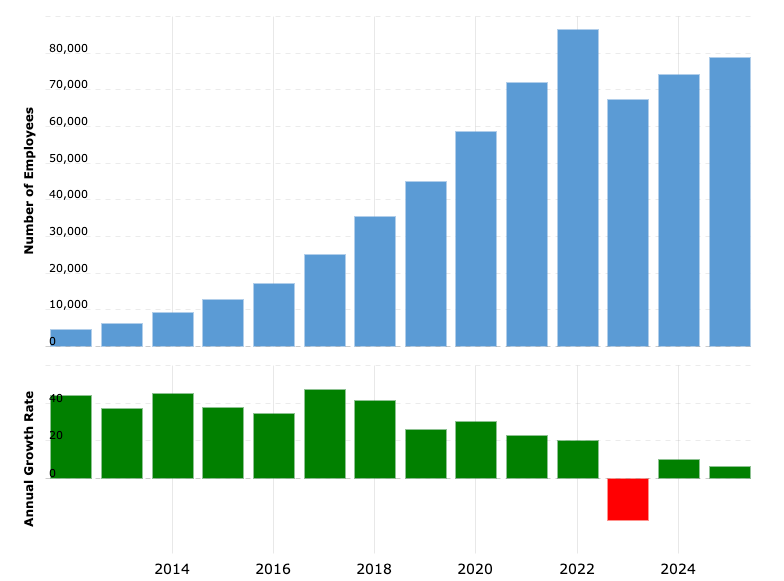
source: macrotrends.net
But announcing that you’re mandating employees to teach their Skills to AI, recording their screens, and then planning a layoff in a month… is tricky business.
After the announcement, a chill set into the company. Managers held meetings trying to bring back morale. The most common phrase I heard was “focus on controlling what’s in your control.” Many managers admitted they had no idea who would get laid off, and described how they are preparing to be laid off themselves.
One VP described to me how he had mentally prepared himself for how he was going to restructure his team and how he was not majorly affected by the emotional side of it, because he had been making such decisions for 4 years now.
At 4 AM, on Wednesday, May 20, people across the company got emails about whether they were: 1) laid off (effective immediately), 2) reassigned to Applied AI, or 3) flattened (managers who lost their team and now had the option to become an individual contributor).
A program manager on maternity leave was laid off, she said “My entire team got cut” - she worked on data security and privacy. A Product Manager who just built a team of 5 lost his entire team and was offered the chance to take an IC role to keep working on his mandate. Many, many engineers found themselves assigned to Applied AI with no idea who their manager was, and a dreadful sense that they’re well-paid data-labelers now.
That evening, the efficient VP who was “mentally prepared to restructure his team” got a call from his best friend at work. Someone he had worked with for 10 years said that they had been “impacted” by the layoff. That phone call hit him like a gut punch. He was horrified at the idea that it could happen to someone so close (closer than the people who work for him).
The day after the layoff, folks returned to the office with many feelings - some felt survivor’s guilt, some felt a renewed sense of imposter syndrome, some felt relief.
There was plenty of performative empathy on display. Managers held meetings to discuss “how we can all support each other during this tough time.”
7 days have passed now.
The dust is swirling in the air… it hasn’t quite settled yet.
All teams were reminded that they cannot miss the goals they set at the beginning of the year even if their team was cut in half … “use AI”. Missing goals would lead to a bad rating for this half.
There will also be no need to write your “impact essay” yourself or give peer feedback anymore. An AI tool called Checkpoint will now assign employees into buckets and assign their grades, and managers can choose to override the AI’s decisions if they are prepared to defend it.
Multiple employees from ICs to VPs who were hoping to get laid off have announced their resignations. Many of them already had other jobs lined up and were just waiting to see if they could collect the severance.
Morale might be down. But App engagement is up, revenue is up, profits are up, and most importantly, the stock is up 4% today.
FTW.
Darth Vader’s stormtroopers live to fight another day.